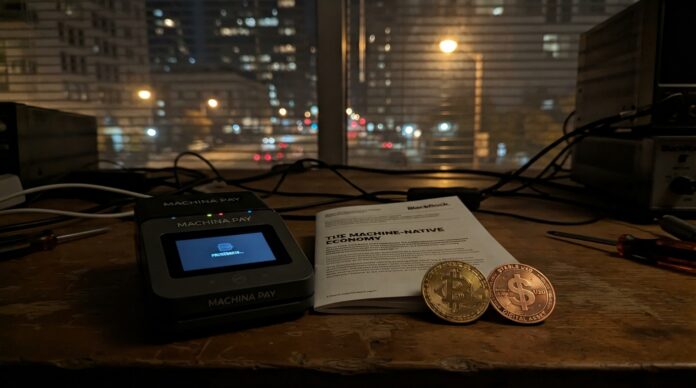
BlackRock has indicated that autonomous AI agents could become the next major catalyst for cryptocurrency adoption. According to the $15 trillion asset manager, these software systems will require a native digital payments infrastructure capable of operating continuously and processing fractional-cent transactions.
The report emphasizes that the convergence of intelligent models and decentralized networks will mark a turning point. Far from relying on human intervention, these software entities will need programmable money to acquire data, rent computing power, and manage their own financial resources in real time.
In his report entitled The Machine-Native EconomyThe global asset manager maintains that Artificial intelligence agents could be the next big driver of cryptocurrency demandThe firm argues that conventional financial infrastructures, such as payment card networks or automated clearing houses (ACH), are inefficient for autonomous commerce. These traditional channels require onboarding processes designed for humans, apply high fixed fees that preclude micropayments, and have slow settlement times incompatible with software-speed transactions.
The machine-native economy and blockchain rails
The financial institution's analysis delves into how the practical applications of artificial intelligence are rapidly evolving. By autonomously performing complex tasks, such as booking services, purchasing datasets, or contracting computing power on demand, these systems require a cost-effective architecture tailored to their operational requirements. Rails based on distributed ledger technology offer immediate settlement 24/7, without manual intermediaries.
Crypto networks allow for the settlement of transfers costing less than one cent per API call or per second of hardware usage. In this environment, digital assets are not only seen as speculative instruments but also as the fundamental operational fuel for machine-to-machine value exchange. Full automation demands open, interoperable, and programmable channels that function independently of banking calendars or territorial bureaucratic processes.
Bitcoin as a store of value and stablecoins for instant payments
The BlackRock document cites research conducted by the Bitcoin Policy Institute, whose controlled simulations demonstrated clear patterns of financial behavior in language models. In these experimental environments, agents showed a consistent preference for stablecoins to execute everyday transactional payments, while choosing buy Bitcoin as the preferred instrument for long-term value preservation.
This functional division outlines a dual monetary architecture for the technology ecosystem. Stablecoins provide the nominal stability required to budget daily operating costs and bill for computing services, while the asset issued under the Bitcoin (BTC) protocol acts as a decentralized treasury reserve, immune to currency devaluation or traditional account freezes. You can explore more about these concepts in the educational resources of Bit2Me Academy.
Tokenization of assets and real-world assets (RWA)
The economic integration of autonomous systems will not stop at purely transactional money. BlackRock points out that the expansion will also encompass tokenized real-world assets (RWAs) and native assets that facilitate settlement across different network layers. As companies delegate treasury and procurement decisions to software agents, these agents will need to manage diversified portfolios directly on-chain.
The asset manager has firsthand knowledge of this market. After receiving authorization from the U.S. Securities and Exchange Commission in 2024 for its iShares Bitcoin Trust exchange-traded fund, the vehicle surpassed $67.000 billion in assets under management, marking the most successful debut in the history of exchange-traded funds. Within the European Union, regulations such as the MiCA Regulation establish a clear and transparent framework for the supervision of crypto-asset service providers and the issuance of asset-backed tokens, facilitating the protected participation of regulated entities in this ecosystem.
FAQ
Why is traditional banking unsuitable for AI agents?
Traditional channels require human identification, impose minimum commissions incompatible with fractional-cent micropayments, and operate with slow settlements during restricted hours. Independent agents need continuous settlement around the clock to pay for calls to servers immediately.
What function does Bitcoin serve according to BlackRock's simulations?
The research cited by the manager indicates that savvy agents use Bitcoin as a long-term store of value to protect their operating capital, while using stablecoins to pay for recurring computing and data consumption.
What role does MiCA regulation play in this technological convergence?
The MiCA regulatory framework in the European Union provides legal certainty and transparency requirements for the issuance of digital assets and exchange platforms. This enables the development of a reliable and supervised infrastructure upon which automated financial applications can be integrated.
The perspective presented by BlackRock confirms that the structural utility of digital assets transcends conventional human adoption. The transition to a machine-to-machine economy will solidify the demand for networks capable of guaranteeing instantaneous transfers and frictionless value storage.
Understanding how artificial intelligence and decentralized protocols interact is essential to assessing the future development of the crypto market within a transparent and secure regulatory environment.
Investing in cryptoassets is not fully regulated, may not be suitable for retail investors due to high volatility and there is a risk of losing all invested amounts.
Generative artificial intelligence tools were used to create this article.