Bitcoin's price fell to $92.000 after more than $860 million in positions were liquidated, driven by fears of a new tariff war between Western powers.
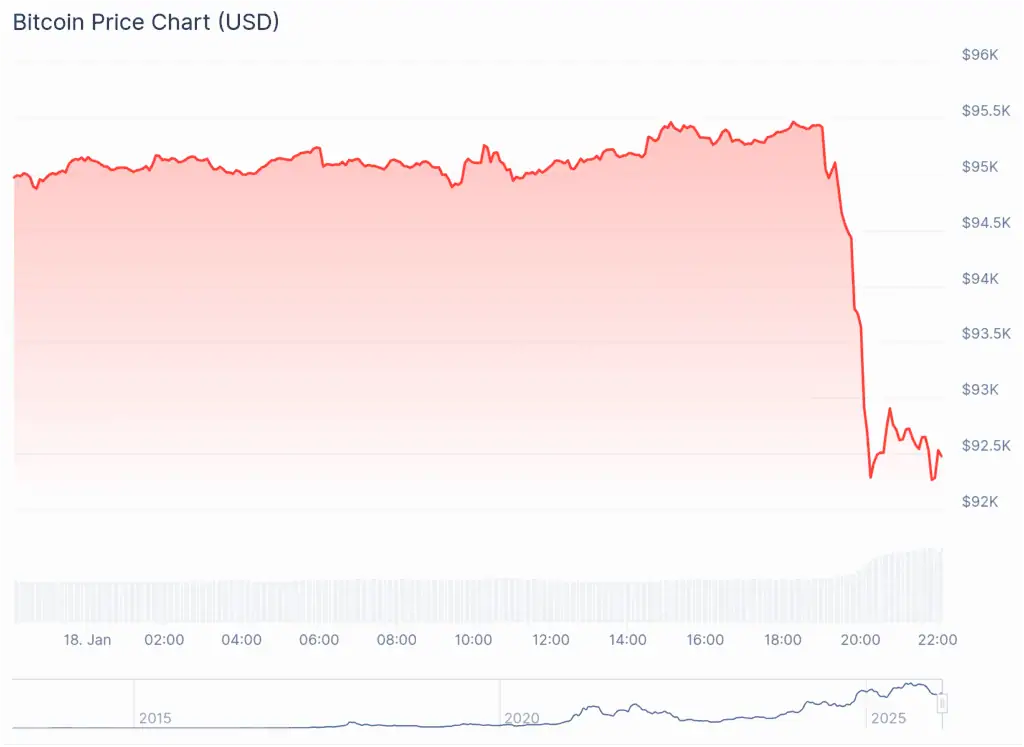
Sunday night marked a sudden shift in the recent trajectory of digital assets. Bitcoin's price experienced a significant pullback, losing around $1.000 per unit in a matter of hours and bringing its valuation close to the $92.000 mark. This bearish move interrupted the relative calm that had prevailed in previous sessions and reminded market participants of the close correlation that currently exists between cryptocurrencies and global macroeconomic events.
This drop in the price of the leading cryptocurrency coincides with the reopening of US futures markets and the resurgence of concerns about foreign trade policies among major economic powers.
Take advantage of the correction and buy BitcoinThe crypto market is reeling amid liquidations and trading fears
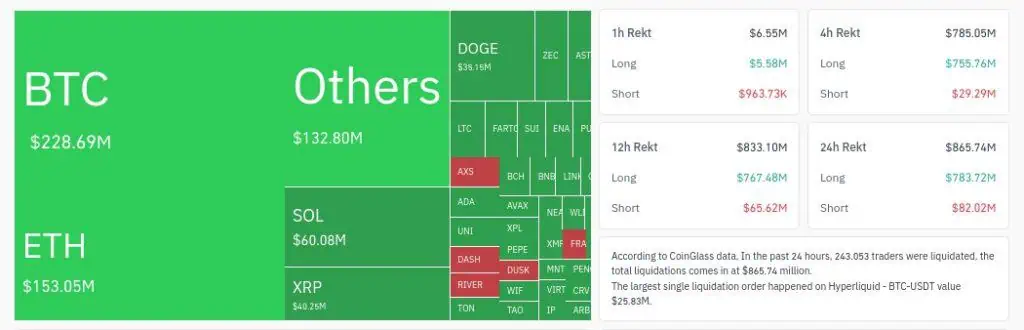
During the opening of the US session, selling pressure in the crypto market intensified with unusual force. Data from derivatives analysts showed a wave of liquidations that exceeded $780 million in long positions Bitcoin and other cryptocurrencies were liquidated in just a few hours. The value of short positions liquidated in the same period reached $82 million, according to CoinGlass data at the time of publication.
This type of movement occurs when a rapid drop in prices pushes leveraged traders out of their margins, triggering automatic chain selling and further exacerbating the market decline. Experts agree that the recorded volume is among the highest in recent times and reflects the fragility that characterizes speculative positions during periods of high economic stress.
Source: CoinGlass
The main catalyst for this financial nervousness appears to be the resurgence of fears about an imminent tariff war between the United States and its trading partners.
Diplomatic disputes and the threat of new trade barriers have generated uncertainty about global economic growth, often leading institutional investors to reduce their exposure to assets considered risky. Although the digital finance ecosystem operates in a decentralized manner, the capital flows that fuel it remain sensitive to the stability of international trade relations.
Bitcoin volatility traded on Bit2MeBitcoin falls back to $92.000 as gold hits a new record
The price of Bitcoin fell to $92.000 in an episode that once again tests the emotional stability of the market.
Until a few hours before Sunday night's correction, investor sentiment showed signs of improvement and a slight return to optimism. The Fear & Greed Index remained above the [insert threshold here]. 45 pointsThis level reflected a phase of neutrality with a positive bias. However, the speed of the collapse revealed how fragile collective confidence remains and how heavily it depends on the absence of adverse macroeconomic news.
Source: CoinGecko
Meanwhile, the global financial ecosystem offers a contrasting picture. According to experts, as Bitcoin's price declined, gold surged, reaching a new all-time high. This contrast further reinforced the perception that, faced with signs of uncertainty, capital continues to seek refuge in traditional assets. This scenario leaves Bitcoin once again in a state of uncertainty, with the market waiting to see if this pullback represents a temporary pause or the start of a broader consolidation phase.
The consolidation of “digital gold” after 17 years of operation
Despite the recent price correction and the noise generated by the international political situation, Bitcoin's fundamental thesis remains robust more than fifteen years after its creation.
It has been 17 years since its launch in January 2009 And cryptocurrency has managed to establish itself not only as a digital asset, but as a technological and monetary alternative with unique properties. Unlike fiat money, which is subject to the decisions of central banks and inflationary pressures stemming from policies such as trade wars, Bitcoin operates under an immutable mathematical protocol that guarantees a limited and predictable offer.
Proponents of blockchain technology emphasize that, while short-term volatility is inevitable, Bitcoin's comparative advantages over traditional assets are becoming increasingly evident in a digitized world. Often referred to digital goldThis asset shares with precious metals the characteristics of scarcity and durability, but adds superior logistical advantages such as extreme portability and divisibility. While transporting large amounts of value in physical gold entails high logistical risks and costs, Bitcoin allows for cross-border value transfers in minutes and without intermediaries, a quality that becomes even more relevant in times of tariff tensions and banking restrictions.
The exponential growth the network has experienced since its inception demonstrates an adoption that transcends daily price fluctuations. The infrastructure surrounding Bitcoin in 2026 is infinitely more sophisticated and secure than in its early years, suggesting that price dips, while painful for short-term leveraged investors, are transitory events within a secular adoption trend.
The narrative of Bitcoin as a store of value superior to the fiat system continues to gain traction, especially as national currencies are threatened by political disputes between governments.
Take advantage of the market: join Bit2Me