Bhutan, the Himalayan kingdom that transformed its hydroelectric power into digital gold, is adjusting its financial strategy. We analyze the reasons behind its recent Bitcoin moves and how state-run mining continues to be the engine of its national development.
What would lead a nation that has staked its technological future on the Bitcoin standard to part with a portion of its digital treasures right now? Over the past few weeks, blockchain ecosystem observers have noticed a steady, rhythmic flow of assets leaving one of the world's most closely watched sovereign wallets. This isn't investor panic or a hasty liquidation, but rather a surgical treasury execution.
The protagonist of this narrative is Bhutan, the small Himalayan kingdom known for measuring its success through the Gross National HappinessHowever, in the financial arena, its metric of success has become profoundly digital.
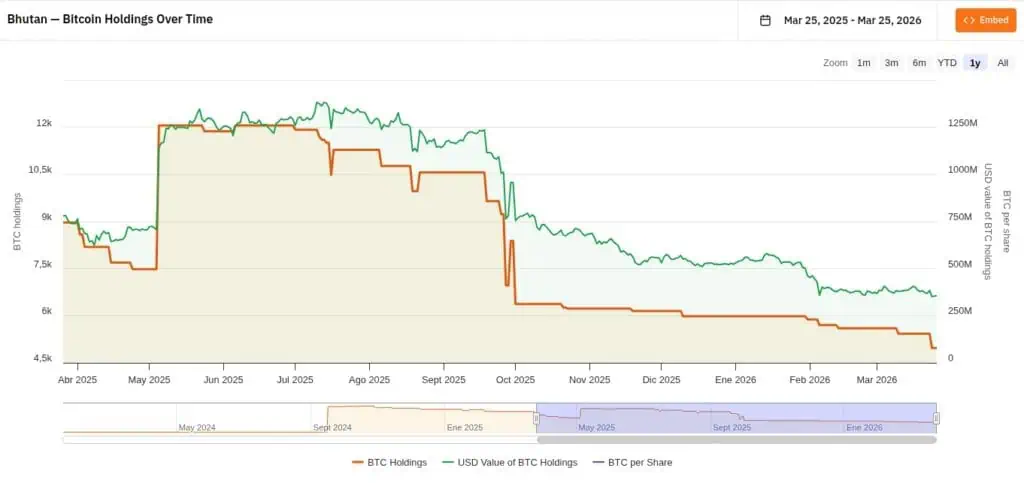
At the beginning of this year, the country held a reserve of nearly 6.000 BTC, solidifying its position as a leader in state adoption of cryptocurrencies. Today, after a series of strategic moves, including the recent transfer of 519 BTC (approximately $37 million), its holdings stand at slightly above 4.900 BTC.
According to experts who closely follow the kingdom's financial movements, this change of pace in its balance sheet is not a setback, but the natural evolution of a country that has ceased to be a mere accumulator and has become an active manager of its crypto resources.
Copy Bhutan's vision: create your own BTC reserveStrategic reserve management in the Himalayan Kingdom
The sale of assets by a state is usually interpreted through the lens of necessity, but in the case of Bhutan, the narrative is that reinvestment and sustainabilityThe country is not abandoning the cryptocurrency ship; it is reaping the rewards of a sowing that began in 2019. Through its investment arm, Druk Holding and Investments (DHI), the kingdom has used Bitcoin as a mechanism to monetize its surplus hydroelectric power, transforming water into liquid financial value.
The movements recorded in March, part of a gradual drawdown process, reflect a planned liquidity policy. According to data from platforms like Arkham and the behavior of its sovereign wallet, Bhutan has been executing sales in controlled tranches of between $5 and $10 million. This methodology suggests that the government is seeking to finance immediate projects without disrupting the market price, acting with the prudence of a high-level institutional investor.
Source: Bitcoin Treasuries
The current context, marked by Bitcoin's market volatility, has forced all mining entities to optimize their balance sheets. For Bhutan, selling a fraction of its digital holdings allows it to cover the operating costs of its vast server farms and, at the same time, inject capital into the country's real economy, demonstrating that Bitcoin is, above all, a tool for tangible progress.
Trade your bitcoins on Bit2Me today: create your accountBhutan leverages its clean energy to power the future with Bitcoin
Bhutan has garnered global attention not for the scale of its Bitcoin sales, but for the way it produces what it has. Nestled in its mountains, it has found a way to link Bitcoin mining with its most constant natural resource: copper. hydroelectric powerThis clean and abundant resource allows it to generate each unit of the cryptocurrency at a cost far below the international average, strengthening its position in a field dominated by countries with greater industrial capabilities.
The government has committed to this activity as a long-term strategy. A 100-megawatt plant is already operating in the Gedu area, with projections for 2025 indicating a total installed capacity of 600 megawatts. The growth in the capacity of these facilities is also aimed at strengthening an even more ambitious project: the so-called Gelephu Mindfulness City, a special administrative zone created to attract technology, innovation and global talent in a sustainable development environment.
In this context of innovation, growth, and development, the recent Bitcoin sales by the government also have a clear purpose. Part of those reserves have been allocated to “Bitcoin Development Pledge”, a commitment that channels funds towards the construction and expansion of the new city.
The benefits of Bitcoin mining are also reflected in the local economy: they help improve the healthcare system, support environmental programs, and sustain various public services. In other words, in Bhutan, digital resources have become a real tool for to promote collective well-being and consolidate its independent development model.
Sign up at Bit2Me and let BTC power your futureThe global landscape of sovereign Bitcoin holdings
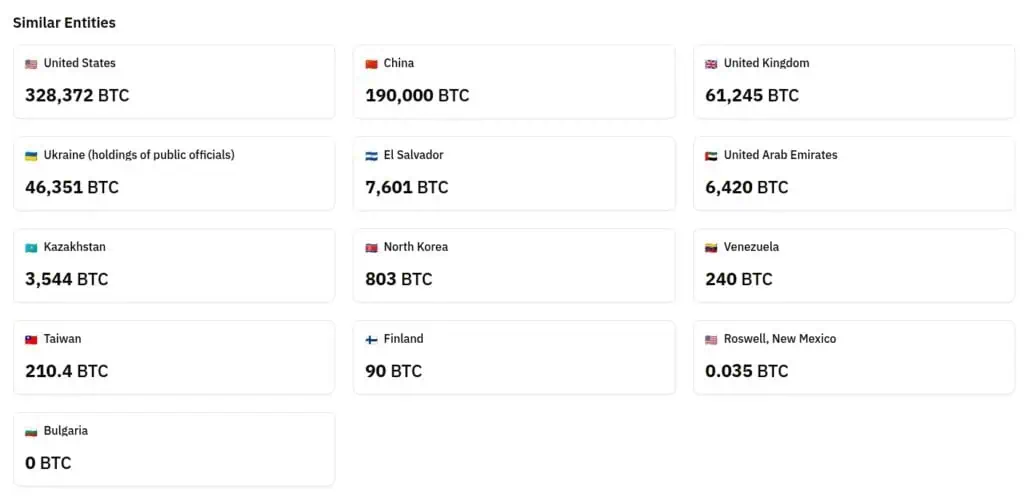
Bhutan is not alone on this financial chessboard, although its approach is unique due to its status as a primary producer. Looking at the global map of similar entities, we see that other countries hold highly relevant positions, albeit for different reasons. United StatesFor example, [name] tops the list with over 328.000 BTC, followed by [name]. China with 190.000 BTC and the United Kingdom with over 61.000 BTC. In these cases, most of the funds come from legal seizures rather than an active mining strategy.
Source: Bitcoin Treasuries
A spectrum closer to the philosophy of Bhutan is found El Salvadorwhich holds approximately 7.601 BTC and maintains a daily purchase policy. Other nations such as Ukraine, with 46.351 BTC, the United Arab Emirates, with 6.420 BTC or even VenezuelaThe 240 BTC attributed to it reflect the diversity of reasons — from store of value to economic resilience — that lead a state to be included in the blockchain.
Despite the recent reduction in its balance sheet, Bhutan maintains a leading position considering its size and GDP. Holding over 4.900 BTC places the kingdom ahead of much larger economies and keeps it a key player in the industry.
This transition from a phase of intensive accumulation to one of strategic management is a sign that the Bhutan experiment has worked: Bitcoin is no longer just a theoretical reserve, but the financial engine that is building the roads, hospitals and cities of tomorrow in the Himalayas.
Join the Bitcoin standard: trade on Bit2Me