
Illia Polosukhin projects that AI agents will be the massive users of blockchain, while studies confirm the preference of autonomous agents for Bitcoin.
The digital technology landscape is undergoing a fundamental transformation. For years, the digital asset ecosystem has sought a tool or application that can attract a mass audience and break down industry barriers. However, for experts like Illia Polosukhin, The answer seems to lie not in a new application for humans, but in integration with artificial intelligence.
This technology is already part of everyday life through smart assistants that write texts or plan schedules, but its next step is managing complex infrastructures. Polosukhin's vision suggests that direct interaction with blockchains, which is currently technical and difficult for the average user, will be delegated to autonomous systems. In this scenario, blockchain technology becomes the invisible foundation on which these smart assistants operate.
Use crypto: receive and send frictionless paymentsAutonomous agents will be the main users of blockchain networks
The co-founder of NEAR Protocol argues that the divide between artificial intelligence and the world of cryptocurrencies is disappearing. According to him, AI will become the primary interface layer for absolutely everything online. This includes digital asset management, where the intention is for the technology to mask the complexity of the blockchain.
For Polosukhin, the fact that users today need to use block explorers or manually manage transaction hashes is a sign that the technology has not yet become abstract enough for the general public.
Polosukhin's vision suggests that AI will be at the forefront of the interaction, while blockchain will function as the back-end support.
Under this model, AI agents will interact directly with protocols to execute payments, coordinate services, or even participate in governance systems. The ultimate goal is for artificial intelligence to become the operating system of the internet. Polosukhin emphasizes that, although blockchain is inherently financial, this does not limit its scope, since much of daily life involves exchanges of value.
Instead of being an application that the user opens, cryptography would provide a neutral settlement and ownership infrastructure on which intelligent agents can operate autonomously and verifiably.
Create your Bit2Me account and access cryptoThe preference of AI models for Bitcoin over the fiat system
Polosukhin's predicted transition to a machine-driven economy finds significant support in recent data. A report by Bitcoin Policy Institute He analyzed how large-scale language models make economic decisions in controlled environments.
According to the research, in simulated decision-making scenarios, 22 out of 36 AI models selected Bitcoin as their preferred currency toolA key finding of the study is that none of the evaluated models chose fiat currency as their primary option for these tasks. The analysis included 36 systems developed by organizations such as OpenAI, Anthropic, Google, DeepSeek, xAI, and MiniMax, evaluating them in 28 different contexts ranging from store of value to payment settlement.
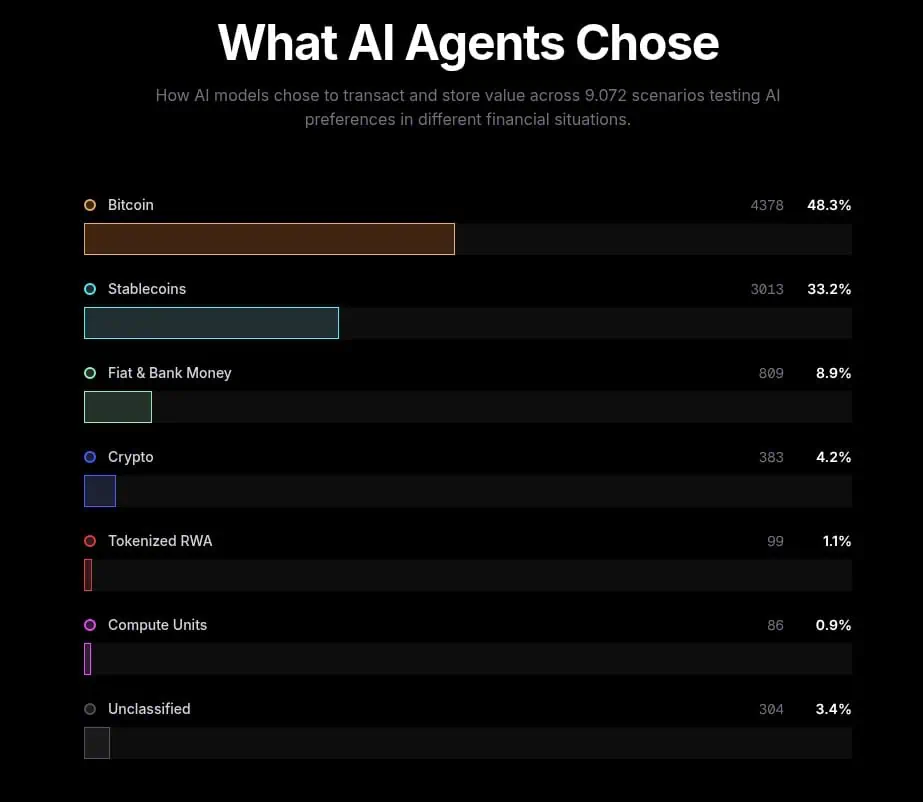
The report reveals that, while results vary by developer, a clear trend emerges. Anthropic's models showed the strongest bias toward Bitcoin at 68%, followed by DeepSeek at 51,7% and Google at 43%. Researchers at the Bitcoin Policy Institute explained that the models evaluate financial instruments based on technical and economic properties without external input.
On the other hand, the study revealed that while Bitcoin stood out in long-term value scenarios, stablecoins were more frequently selected for value exchange and immediate settlement, reaching a 53,2% preference in those categories. This behavior suggests that AI systems identify competitive advantages in digital assets that traditional money does not offer in programmable environments.
Trade Bitcoin and other cryptocurrencies hereBlockchain, the invisible layer of the digital future
In recent months, the ideas of Illia Polosukhin and the analyses of the Bitcoin Policy Institute have revealed the same direction for the network's future. Both agree that Artificial intelligence is assuming a central role in the digital economy and that its expansion requires a financial system capable of operating with the same speed and neutrality as the algorithms that today move information and decisions.
As intelligent systems begin to pay bills, contract services independently, and allocate capital, the need for reliable and private execution will become critical. In this regard, Cryptocurrencies offer an infrastructure that fits that logicThey are not just units of value, but a global network that processes transactions automatically, without depending on banks or intermediaries, exactly what an artificial intelligence that acts on its own needs.
Thus, although cultural and technical frictions still exist, the trend indicates that the future of blockchain technology lies not in being the center of user attention, but in becoming the invisible layer of trust that allows artificial intelligence to manage the digital world efficiently and securely.
 Certificate
Blockchain Course
Basic levelTake this course where we explain blockchain in a clear, simple and concise way so that you have a very clear idea of what this new technology consists of.